













Mass Spectrometry Principle of the Helium Mass Spectrometer Leak Detector
Publishdatea:2019-09-26 Views:267
The helium mass spectrometer leak detector is a hermeticity testing instrument based on the principles of mass spectrometry, using helium as the tracer gas. Its mass spectrometry principle is shown in the figure.
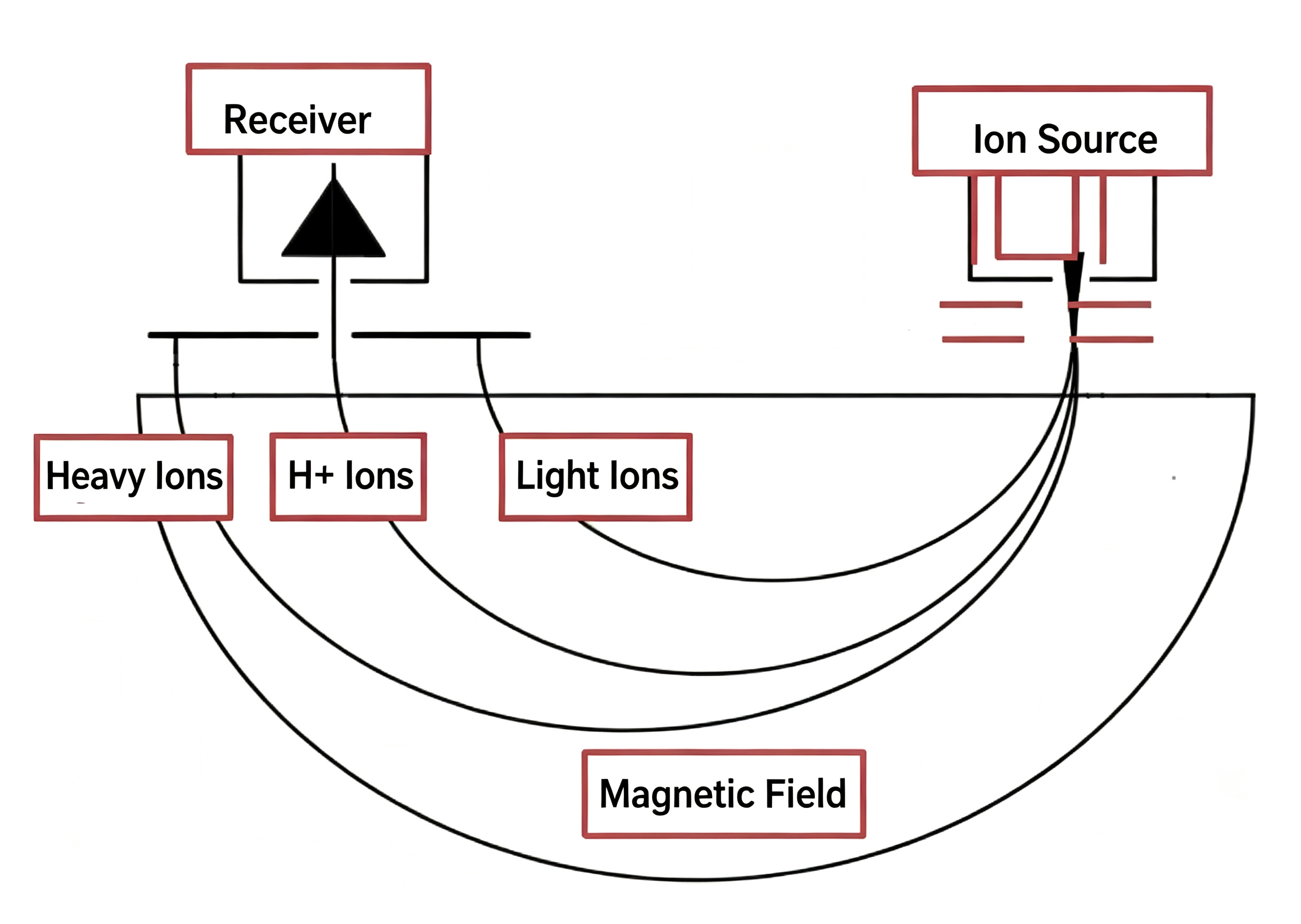
Electrons emitted from the filament oscillate back and forth within the ionization chamber, colliding with gas molecules in the chamber and with helium that has entered through leaks in the test piece, thereby ionizing them.
Mass Spectrometry Principle of the Helium Mass Spectrometer Leak Detector
The filament emits positive ions, which enter a magnetic field after being accelerated by an electric field. Due to the Lorentz force, they are deflected into circular trajectories. The orbital radius is given by:
where R — orbital radius of ion deflection (cm)
B — magnetic field strength (T)
M/Z — mass-to-charge ratio of the ion (positive integer)
U — ion accelerating voltage (V)
From the above formula, it can be seen that when R and B are held constant, varying the accelerating voltage allows ions of different masses to pass through the magnetic field and the receiving slit to reach the detector for measurement.
The helium mass spectrometer leak detector is a hermeticity testing instrument based on the principles of mass spectrometry, using helium as the tracer gas. Its mass spectrometry principle is shown in the figure.
Electrons emitted from the filament oscillate back and forth within the ionization chamber, colliding with gas molecules in the chamber and with helium that has entered through leaks in the test piece, thereby ionizing them.
Mass Spectrometry Principle of the Helium Mass Spectrometer Leak Detector
The filament emits positive ions, which enter a magnetic field after being accelerated by an electric field. Due to the Lorentz force, they are deflected into circular trajectories. The orbital radius is given by:
where R — orbital radius of ion deflection (cm)
B — magnetic field strength (T)
M/Z — mass-to-charge ratio of the ion (positive integer)
U — ion accelerating voltage (V)
From the above formula, it can be seen that when R and B are held constant, varying the accelerating voltage allows ions of different masses to pass through the magnetic field and the receiving slit to reach the detector for measurement.